

 Vachana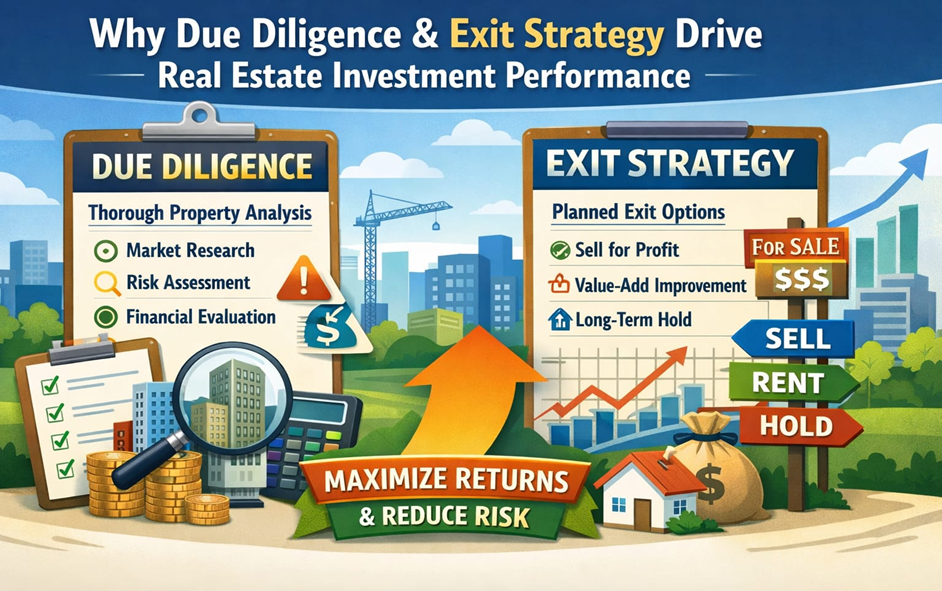
In real estate investing, success is rarely accidental. While attractive properties and strong market conditions help, long-term investment performance is primarily driven by process—specifically, rigorous due diligence and a clearly defined exit strategy. Investors who consistently outperform the market understand that profits are made not only when buying well, but when planning the entire lifecycle of an investment from day one.
🟠Understanding Due Diligence in Real Estate Investing
Due diligence is the systematic evaluation of a real estate investment before acquisition. It goes far beyond a surface-level inspection and focuses on uncovering risks, validating assumptions, and confirming that a deal aligns with investment objectives.
Key components of real estate due diligence include:
- Market Analysis: Evaluating local supply and demand, rental trends, vacancy rates, and economic drivers
- Financial Review: Verifying income, expenses, cash flow projections, and return metrics
- Physical Inspection: Assessing the condition of the property, deferred maintenance, and capital expenditure requirements
- Legal and Regulatory Review: Confirming zoning, permits, leases, title, and compliance issues
Thorough due diligence allows investors to make informed decisions, negotiate effectively, and avoid costly surprises after acquisition.
🟠Why Due Diligence Directly Impacts Investment Performance
Investment performance is fundamentally tied to the accuracy of assumptions made at the acquisition stage. Poor due diligence can lead to overestimating income, underestimating expenses, or misunderstanding market dynamics—all of which erode returns.
Strong due diligence helps investors:
- Identify hidden risks before capital is committed
- Accurately price assets and avoid overpaying
- Structure deals with realistic return expectations
- Build confidence with lenders and partners
In short, due diligence protects capital and sets the foundation for sustainable performance.
🟠The Role of Exit Strategy in Real Estate Investing
An exit strategy defines how and when an investor plans to realize returns from a property. Common exit strategies include selling, refinancing, holding long-term for cash flow, or repositioning and exiting at a higher valuation.
Importantly, the exit strategy should be defined before acquisition—not after. It influences nearly every investment decision, including:
- Target purchase price
- Renovation scope and budget
- Financing structure
- Hold period and risk tolerance
Without a clear exit strategy, investors risk being forced to sell under unfavorable market conditions or holding assets that no longer align with their goals.
🟠How Exit Strategy Drives Better Decision-Making
A well-defined exit strategy provides direction and discipline. It ensures that operational decisions remain aligned with the intended outcome of the investment.
For example:
- An investor planning a short-term sale will prioritize market timing and value-add improvements.
- A long-term hold investor will focus on stable cash flow, tenant quality, and operational efficiency.
By planning the exit early, investors can adapt to market changes without losing sight of their performance targets.
🟠The Power of Aligning Due Diligence and Exit Strategy
Due diligence and exit strategy are most effective when they work together. Due diligence validates whether an exit strategy is realistic, while the exit strategy determines what aspects of due diligence matter most.
When aligned, investors can:
- Stress-test returns against multiple exit scenarios
- Adjust acquisition criteria based on realistic market conditions
- Reduce downside risk while preserving upside potential
This alignment transforms real estate investing from speculation into a disciplined, repeatable process.
Conclusion
Real estate investment performance is not defined by luck or intuition—it is shaped by preparation and planning. Due diligence ensures that investors understand what they are buying, while a clear exit strategy defines how value will ultimately be realized.
Together, these two elements form the backbone of successful real estate investing. Investors who commit to disciplined due diligence and intentional exit planning position themselves to manage risk effectively, capitalize on opportunities, and achieve consistent, long-term returns.